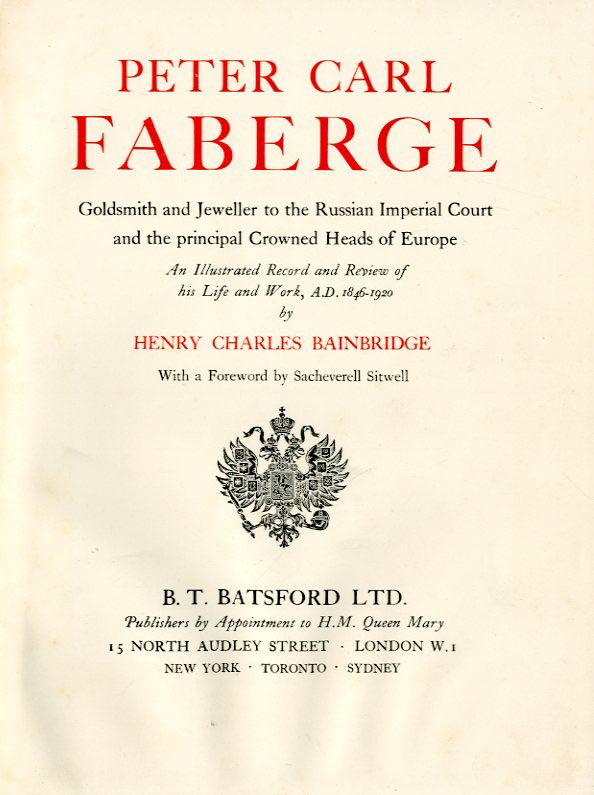
BAINBRIDGE (Henry Charles).— PETER CARL FABERGE. Goldsmith and Jeweller to the Russian Imperial Court and the principal Crowned Heads of Europe. ‘An Illustrated Record and Review of his Life and Works, A. D. 1846-1920 by’ [...]. With a Foreword by Sacheverell Sitwell. B. T. BATSFORD LTD. ‘Publishers by Appointment to H. M. Queen Mary’. [...]. New York - Toronto - Sydney. 1949. In-4.º XXIV-169-I págs. E.
“In the history of the goldsmith’s art there is no more remarkable a figure than Peter Carl Fabergé. There is something strangely inevitable about him. His personality and art remain to be reckoned with whether we will or no.
“look around to-day wherever fine work of the goldsmith is displayed and you will almost invariably find the notice ‘By Fabergé’. Nothing can tell more eloquently of the man and his work than the compelling attention which his creations still evoke.
“Fortunate in everything he undertook during his amazingly active life, Fabergé was doubly so in that he lived and worked in the time of the great art patrons of the end of the Nineteenth Century and the beginning of the Twentieth, a period which culminated in the Edwardian Era (an era not peculiar to England — but one the influence of which overspread the world). It was then that he reached a pinnacle of fame which even the masters of the Renaissance might have envied. Proclaimed by Kings, with Ambassadors as his heralds, Fabergé, through the medium of his art, made his influence felt in almost every corner of the globe.
“It would seem enogh that this Craftsman should have so impressed himself upon his age, but fortune again stepped in and what was tragedy unheard of for the Romanoffs, for him become the wheel which turned to yet more fame. In the Palaces of the Tsar many of the Imperial Easter Eggs were found, marvels of craftsmanship and ingenuity, and a large number of other objects.
“For the second time the name of Fabergé become one to conjure with, and this time almost a household one. Soon everything which was found on the writing-tables of the Tsar and the Tsarina, the Grand Dukes and the aristocracy of Russia, whether the work od England, France, Russia, Italy or Germany, came to be attributed to him. In yhe markets of Europe pieces appeared which were no more Fabergé’s than Cellini’s. [...]”.
Edição ilustrada em folhas impressas à parte, com a reprodução de inumeras obras deste genial artista. Primeira edição.
Encadernação editorial em tecido, bastante manchada. Nas páginas 155 a 169 com um corte de traça que só tangencialmente ofende a mancha tipográfica.
Para adicionar produtos à sua lista de favoritos, precisa de iniciar sessão ou criar uma conta.