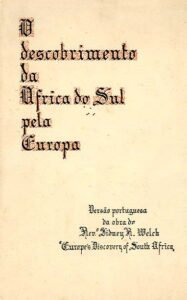
PORTUGUESE AND DUTCH IN SOUTH AFRICA

WELCH (Sidney R.).— PORTUGUESE AND DUTCH IN SOUTH AFRICA. 1641-1806. [...]. Juta & Co., Ltd., Publishers and Booksellers, Cape Town and Johannesburg. 1951. In-8.º gr. de VI-944-II págs. E.

“This volume deals with the rise of our South African people; who now began to share peacefully with Portugal this sub-continent of ours. A Portuguese priest of the seventeenth century wrote that history can give light, but it cannot give eyesight. Periods of history pass away and are often forgotten, the names of once famous leaders being buried in oblivion or in musty archieves. Yet the same himan episodes constantly recur, and can be discerned by the attentive historian. Because these events reveal men like ourselves at work; they also disclose the qualities of leaders and the principles, or lack of principle, that guided them.
Among the richer nations of the last century too many patriotic historians have glorified a mythical principle called individualism. No human being can escape the fate of being an individual. What really matters is the kind of individualism that he cultivates, by disciplining his own shortcomings. Thomas Carlyle infected the atmosphere of the richer nations during the nineteenth century with the idea that the greater force is the real manifestation of the Universal Mind. It was a notion dear to everyu bully.
“Our South African people stands to-day on the threshold of great material prosperity, partly due to the political and moral blumders of those powerful national leaders, who held the greatest wealth at the beginning of our century. We have seen how a cad’s policy among the nations can lead to needless war, and how a cad’s method of waging war inevitably leads to a cad’s peace. Only the Christian spirit, with the sacrifices in money and trade that it often involves, can guarantee a peaceful prosperity among the nations, in proportion to the resources of each nation. King Manuel of Portugal once wrote that the distinctive feature of the virtue of justice is the thought of the rights of others. [...]”.

[...]”.

Encadernação dos editores. Discretamente assinado no verso do frontispício.

P.f. envie-nos a sua mensagem.
Enviaremos a nossa resposta o mais breve possível.